Showing posts with label First. Show all posts

Monday, 22 May 2017

Dark Souls : The Board Game - Review!

Hello again, and welcome back to the Dark Ages!

This post is going to be a bit of a special occasion - I hadn't really foreseen myself reviewing games, but while I was unboxing and trying out my copy of Dark Souls : The Board Game (funded on kickstarter quite successfully) I found myself taking notes of my thoughts on production quality, materials, and rules. This was all intended for my own personal use, as references for do's and don'ts should I ever produce a board game or other game (which I would like to eventually), but it occurred to me that it was also, in effect, a fledgling review. Above and beyond that, I thought some of the things I was writing differed from other reviews I've seen online, and would probably be useful for prospective buyers of the game. I mean, I don't fancy many people are going to see my blog, based on the analytics, but if they do, hopefully they can see something useful here.

So, enough with the intro guff, on to the review!

This review will be divided into four broad segments. The first, Materials will cover all the tokens, miniatures, game boards, cards and wooden pieces that you will use to play the game. 

The second, Rules, will cover the quality and presentation of the rulebook, its usability, and the overall impression before play for a new player. 

The third, Gameplay, will provide my experiences playing the game solo and two-player, which I imagine will be the modes most people want to play a Dark Souls game in, as well as a discussion of those experiences and what they might mean for prospective buyers. It will also touch on the relationship between the board game and the original video game, which should be a useful touchstone for many who are interested in purchasing this game at the moment, as I imagine many will have come from the digital world.

Finally, I will summarize the review with some arbitrary scores, because people love those, and give some closing statements to qualify my conclusions.

Materials

We begin by looking at the materials provided with DSBG (which is how I will summarize the game's title from now, on for brevity), as these will not only be the first thing you look at when you open the box, but will also be instrumental in actually playing the game, so their quality is quite important to the quality of the game overall.

The first thing you may notice when the box is opened and the materials are exposed is that there are a lot of them! Organization will be key to keep your game from grinding to a halt as you search for a particular soul or wound token in the mound. I placed mine in individual, labelled ziploc bags that I was able to lay out in a logical manner after my first couple of playtests to make finding the required components at any point in time fairly smooth.

The packaging the materials first come in is of varying utility. For the cards, the flimsy plastic rack they come is is utterly useless, with no dividers for the various decks and no way to place it in the box so it does not tip or shake when travelling and ruin any sort of organization. For my purposes, I organized the cards into their decks and packaged each individually in a ziploc bag, as I mentioned doing above. For the miniatures, their racks are somewhat more useful. Being shaped to hold the pieces, they will keep the minis organized under most conditions, though due to the material they are made from (more on that later in this section) I refrain from pushing them fully back into their plastic racks, instead letting the packaging cradle them in place.

The wooden cubes, used for tracking the status and attributes of the player characters, are of good quality, being evenly shaped and smooth on all faces. The wood grain is visible through the paint, and lends them a pleasant aesthetic overall.


The cubes.

The dice, probably to be the most used items out of this box, are of varying quality. They come in four different colours, indicating three degrees of attack/defend dice as well as a dodge die, and have had their pips replaced with thematic symbols (an axe swinging on the green dodge dice, and swords on the other dice). These are required in place of other dice for gameplay due to the varied numbers of pips on their faces, ranging from 0 to 4 for the attack/defend dice, but can easily be replaced with result tables and ordinary dice if you are playing with someone who does not have the dice, such as in my two player trials.

When I mentioned the varying quality of the dice, this is specifically in relation to the coloration on their "pips." While most of them are solidly coloured, many are chipped and wearing away right out of the box. This, to me, does not bode well for their lifespan if they are to be used regularly as part of play, particularly since the chipping was most apparent on my black dice, the lowest level of attack/defend dice, and therefore the ones that tend to see the most use in play. The symbols on the dice faces are inset, which should allow repainting by the user, though I would readily argue that shouldn't be necessary straight out of the box.


The dice laid out for a photo. Chipping is evident on all the top faces of the black dice, in the foreground.

The cardboard elements are of decent make overall, with nice full colour and high resolution illustrations on them of the play areas, the characters, and the various token symbols. Their number, as mentioned above, may be daunting (though not if you've already punched out every token in the OGRE Designer's Edition - then you have truly seen the elephant as far as token punching and organization is concerned) but organization will alleviate the load somewhat. The lamination on some boards appears somewhat weak, as just from punching them out, I noticed that if you did not push them out in the right direction, you ran the risk of fully splitting a board in half, or, as I did in one location, peeling parts of the printed face off. Fortunately, in my case, this occurred on the back side of a character board, and so should never be visible to anyone. Good amounts of care being put in to punching the board elements should avoid any damage, but it is not hard to imagine the unfortunate who expects these counters to be as easy to punch and solid as those I've seen in other games punching one of the character boards and causing damage to the game before he or she has even played it.


The peeled sections on the backside of my Knight character board.

It is also worth noting that while no other element of the game requires assembly, the spinners for boss health and bonfire sparks do need to be put together, and the rules include no instructions to do this. You have a small ziploc bag containing the two halves of the plastic centre axis for the spinners, and the two halves of the spinners on sprues to punch out. I realized it fairly quickly due to having seen similar elements (pre-assembled, normally, or with a mention of assembly in the rulebook) in other games, but again, thinking of the new user picking this up, this may provide an obstacle to entry and increase the setup time and frustration.

The cards are, overall, quite well done. They are of good quality material and their colours are vibrant. All information is readily visible on their face. The only thing I have noticed is that, at least in my set, there was an error in their production. Where the rules state that bosses and mini-bosses should be differentiated by the symbol on their cards, a skull with a crown and a skull without crown respectively, my cards show the same symbol for both bosses and mini-bosses. This does not impact gameplay, particularly since I have my cards pre-sorted, but it is an error, so it's worth mentioning.


The Winged Knight, a mini-boss, and the Dancer of the Boreal Valley, a boss, side by side. Note the symbols at centre-left of the cards, both skulls with crowns, the symbol for bosses.

Now on to the miniatures. Those of you of like mind to me may have been most excited at the prospect of a slew of Dark Souls themed miniatures, not only for use with this board game, but potentially for using with other sets of rules, or even as tokens in tabletop role-playing games. The variety is exactly as advertised on the Kickstarter campaign, so you will not be disappointed there.


The miniatures in their plastic packaging

However, those same like-minded individuals will also probably be used to crisp hard plastic or pewter sculpts. Those will not be found here. The miniatures in DSBG are (likely relatively cheaply) moulded of quite flexible soft plastic, and all the hazards of this type of production are found here. This material also meant that punching them out of their packaging was a nerve-wracking experience, as I could feel the weapons bending even further, and glued-together elements wanting to part - hence simply nestling them in the plastic for organization, rather than pressing them back in.
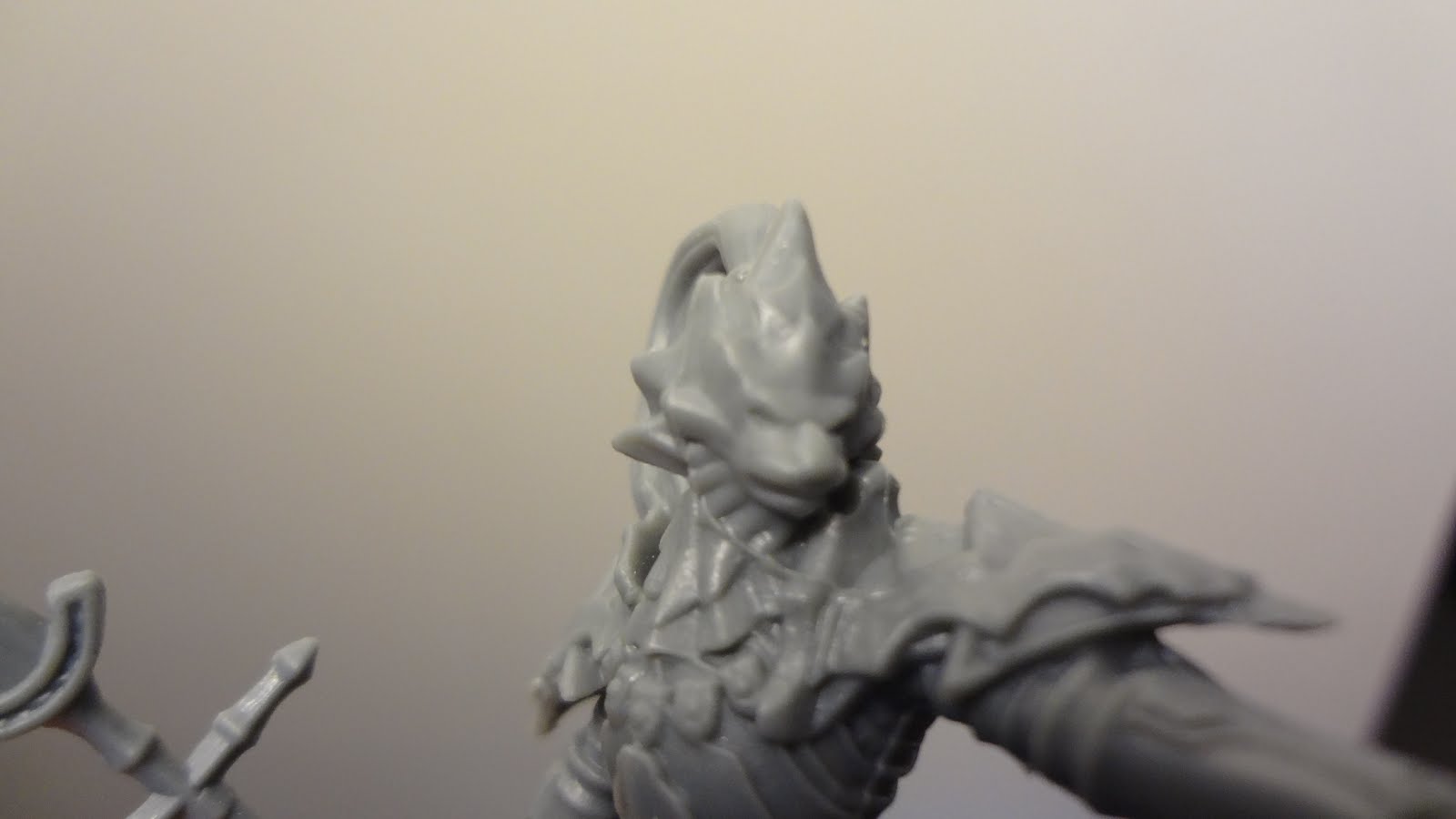

Muddy or soft details, such as on Dragonslayer Ornstein's helm (contrast it to the detail on his breastplate)


Incomplete casting and warped weapons, such as on the guard of the Knight's longsword and the blade itself. If you look at the guard, you will see that the side facing the Knight is not fully cast. The same is particularly evident on my Hollow Soldiers, no two of which have the same length or shape of sword, though in that case the moulding bug will become a feature - broken straight swords all around.


Speaking of warped weapons, the umbrella this Silver Knight is readying to fire looks more like a limp noodle. Not up to the challenge today apparently.

Additionally, the models were cast in many pieces and likely glued together in the factory, so join lines are sometimes visible - they are normally strategically placed at joints in the model anyway, though, and should not be obtrusive to anyone not used to assembling their own miniatures.

The upside to this production quality, of course, is the cost. At approximately 120 USD for not only this set, but all expansions, my own purchase on Kickstarter was quite the bargain given the volume of miniatures I expect to receive. For those purchasing only the base game at that price retail-side, the deal is perhaps less good. I can only say that many of these imperfections can be mitigated with a few coats of paint and perhaps some weapon replacements, for those who know how to do it. If they are worth the trouble to you, you certainly can't go wrong with this for Dark Souls themed miniatures.

I should also mention that they are approximately 35mm scale, for those who are considering using them with other ranges, though because of their proportions they seem a bit lanky compared to other, more heroic 35mm miniature ranges.


The Herald, pictured between two Warhammer Age of Sigmar miniatures from my copy of Warhammer Quest : Silver Tower .Taking into account his bent knees, he seems roughly as tall as they are. Bonus internet points if you can identify the book they are posed on.

Overall, the quality of materials is acceptable for the board game, though I have doubts about the durability of almost all elements. Those of you who are a bit less picky, of course, may find absolutely nothing wrong with any of this. I leave it up to you.

Rules

The rules are presented in a 38 page. full-colour manual, whose back cover is dedicated to a decent quick reference sheet (though I found in gameplay that it didn't quite cover everything I wanted to look up, and covered many things I wasn't particularly concerned about. Mileage will vary.) and whose overall theming and aesthetic is quite effective. Visually, the rulebook is a success, appearing accessible and maintaining the Dark Souls aura about it.

As far as the rules and their communication goes, the results are, again, varied (I'm beginning to sound like a broken record, I fear). Overall, the rules are fairly comprehensive, if only because the game is conceptually quite simple. Using the table of contents at the start, sections of the book can be found easily for future reference. The lack of a glossary or index, however, seriously hinders its utility as a reference during play - some gameplay elements are oddly sorted, and remembering which section they are in to find it in the table of contents is often slower than simply flipping through the entire book two or three times until the paragraph you're looking for jumps out at you.

There are many images, helping to present elements of play like the different information elements on cards or the way that miniatures can move, and this is very effective in making the rulebook accessible and easy to understand.

One thing that confused me, particularly given the lack of an index or glossary for key words, is the intermittent bolding of what are clearly meant to be key terms in the rules. For example, in one section, the words "change equipment" are bolded, but are found bolded nowhere else in the manual, and can't be looked up specifically, so why did you bold an otherwise unremarkable expression? Likely, they wanted to make sure that changing equipment in these rules meant something specific, but this is not made clear by the manual. It does not hinder understanding, but it does not help it either, and makes me wonder if perhaps the rules were meant to have an index after all, but it was cut for page count and the manuscript was not looked at again afterwards.

Gameplay

This is perhaps where most people will be truly disappointed by DSBG. I have seen it described in other reviews online as suffering from its fidelity to the video game series, but that is patently incorrect. If that were the case, fans of the video game, at least, would appreciate its mechanics and enjoy the slog. DSBG does not mechanically or spiritually follow from the video game, as far as I am concerned, and that is the reason for its weaknesses. If it were truly loyal to the video game, then the issues I will identify with its gameplay would not exist, really.

Prepare for many comparisons to the video game series, since #1 they are apparently the same franchise, since it's fair, and #2 the video games are an immensely better experience, and so can help us suss out what went wrong with the board game.l

Perhaps the most fundamental difference between the video game and the board game probably occurred at one of the first planning meetings for DSBG's creation. Someone likely said "people like Dark Souls because it's hard and they die a lot," wrote that on the white board, and it became the mantra for the board game without any understanding of how, exactly, the video game creates and manages its difficulty for a rewarding experience. The Board Game is also painfully aware that, yes, it is a board game, and board games use dice. Those of you who played the video game may have been curious about whether mixing random chance into the formula would work. It, in my opinion, does not.

Randomness is everywhere in DSBG, and dictates every element of your game. All starting weapons and armour use dice that can potentially result in a null effect, no damage inflicted or blocked, and dodge dice only have a 50% success rate. This means that a slew of bad rolling can (and did, regularly) mean that no matter how much strategy you think you're employing, no matter how well you've learned the enemies' moveset (not difficult, since they perform the same action turn after turn) you can die to a hollow soldier after both of you whiff for six rounds with full damage block followed by 0 damage inflicted. This, as you may have guessed, is not a satisfying gameplay dynamic. Quite the opposite.

When you have randomly blundered your way to success in an encounter, you are rewarded with Souls, the experience points and currency of the DSBG. This reward is the same no matter what encounter you do, so get used to receiving only enough Souls to perform the initial upgrade to one attribute or to acquire two random items from Andre the Blacksmith. Players of the video game will now say "well, if you're good enough, any equipment or any attributes are fine for getting through Dark Souls." Sure. They would be if your skill had anything to do with this game. Attributes are necessary only to let you wield newer items. They do not impact your rolls or performance in any way. The only things that do that are your equipped items, which makes good equipment essential to being able to succeed.

Do note that I mentioned that all loot is random up above, so enjoy the game where you get nothing but gems to enhance your starter weapon that has no upgrade slots.

Your equipment determines how well you can dodge, how much damage you can do, and how much you can block. However, it does none of these deterministically, either. All of this is based on chance. With armour that provides you three block dice, you can still be hit by an easy attack and have your plans thrown awry simply because you rolled no successes.

Yes, these are the realities of dice-based board games, but they do not mesh well with the spirit of the Dark Souls games, nor do they provide any sort of fun challenge within this game as designed. All they do is frustrate you when they fail, and permit you to keep playing the game when they succeed.

Dark Souls the video games have carefully crafted levels, where loot is strategically placed and enemies are specifically selected to reward exploration, to test your skill as a player, and to provide choice in how to advance through an area. In the board game each and every one of those features is up to chance, which leaves... what exactly for the player to do?

Overall, rather than reminding me of a challenging but exciting role-playing game, this reminds me more of those old games where you play a submarine or bomber crew (for example https://boardgamegeek.com/boardgame/1032/b-17-queen-skies), and just roll to see what happens to them over and over again. The major difference here is that those games, at least, generally had some choices for the player to make. In Dark Souls, you have a degree of choice as to where you will move, but if you want to hurt the enemy, you move towards them, while avoiding where their friends will go as much as possible to limit how many people are hitting you. Prepare to determine an optimal strategy the first time you enter a room, determining where to move based on the enemies' single action, then try that room over and over until you stop rolling 0 damage so that your plan can actually work.

The Boss battles suffer from the same thing, so while I would like to say that they are exciting and interesting (and the boss deck mechanic is genuinely fun, at first), frankly, sitting around for two and a half hours fighting the same boss while dodging the same attacks in order to go in and probably inflict no damage is not the definition of a thrilling game experience.


via GIPHY

Okay, I think I've gone over the fact that the game is entirely random and robs the player of any agency in the outcome enough. Let's move on to some other comments, then sum up.

This is a personal preference thing, but Dark Souls the video game is in many ways a solo experience that can be enriched by playing online with friends or strangers, but does not suffer by being enjoyed alone. In DSBG, solo play, even with their bonus Souls to get you started (which may enhance your stats in anticipation of items in the future without improving your luck at all now, or buy you random items... which may or may not be useable by your character without stat enhancement...) seemed almost impossible. You cannot disperse damage, so every enemy rushes towards you, pens you in, and hits you (and the odds are they will hit you) and you get to roll one attack every time every enemy goes through their cycle of rushing and hitting you. Excellent. My hopes had been up for a game I could throw down on a table on the weekend and get some fun out of, but that does not seem likely.

Of course, since the game generally involves rolling until failure then repeating the exact same things again hoping for different results (oh, hey, didn't see you there Einstein), good luck getting any friends who hate fun and have nothing better to do with their day to play a second game with you.

Summary

All of this comes together to what many other reviewers have said : Dark Souls is a boring board game, at least with the rules as written. This is not, however, because it is "too true" to the source material, but rather because of all the myriad ways it differs. Where Dark Souls is a carefully crafted, fair experience with interesting lore and beautiful environments to experience, DSBG is a fully random experience of trudging through tunnels towards a mildly more interesting (for the first half hour) boss fight.

If it were a video game, DSBG would be a roguelike, and not a good one like Dwarf Fortress' adventure mode, or Dungeons or Dredmor or something either. Random tunnels, random enemies, random attack results, except instead of being processed in milliseconds while you mash the arrow keys you need to fish around for tokens and roll dice and spend fifteen minutes+ in that one fight.

However, there is a glimmer of hope - If you just want DSBG for the materials, they are of an adequate standard, and I can think of no better or more cost-effective way to get Dark Souls miniatures at the moment, particularly for the bosses. This all means that the game is ripe for modding, and I intend to do just that. While the greatest weakness of the game is its rules, there are no board game police saying I need to ever follow them again. With tweaks to the loot deck, encounter structure, and damage and stamina management, I am looking at a far more playable, and potentially even faithful to the source material, version of DSBG. If they work out for me over some playtesting, I will publish my homebrewed rules on this blog for you to enjoy.

DSBG is not the worst board game I've ever played, but the best thing to come out of it was that I started playing the video games again. If you like painting minis and want to have a toolset to tabletop some Dark Souls themed stuff, this may be the box for you. If you actually want the Dark Souls experience, spend the cost of the board game on a used PlayStation 3 and Dark Souls the video game (or, if you have the console already, pick up Dark Souls 3 - probably the best of the bunch).

All that said, I hope this gave you a fresh perspective on Dark Souls : The Board Game. It may come off as scathing, but I hope that you can see there's something constructive there too. As I mentioned at the start, I started writing this as notes for myself on game-making, and perhaps it'll give you something to think about for your own homebrew games and how to manage the player experience in those too.

I look forward to seeing your comments on the subject below!

Sunday, 23 April 2017

Bledore vs Sablenoir - Skirmish on the Sangchaud

Hello again, and welcome back to the Dark Ages!

This is going to be the promised Battle Report between Bledore and Sablenoir, using the FiveCore Company Commander rules.

If you want all the background info you could need, check the previous post. Since that's already out of the way, we're going to dive right in.

Today's occurrence is an example of the kind of engagement that occurs regularly along the Sangchaud. While the UN observers are away, two platoons of militia troops from Sablenoir have crossed the Sangchaud to collude with locals on the West bank, reminding them of their true allegiances and seeing if they have any good information on goings-on in Bledore. They have travelled there in an old military truck, but are accompanied by a BRDM, stolen from the old Beauchamps garrisons during the civil war.

While some of the locals are sympathetic to Sablenoir, for most the war is in the past and they are tired of it. When the militiamen pull up, one of the farmers gets on the phone to the local Bledore reserve unit, and before too long, two M113s roll up the road. The Bledore troops dismount and fan out. Here is a photo of their initial positions. (the blue to the left of the photo is a small offshoot of the Sangchaud - West is near the camera, East away from it)


And here is a view of the Sablenoir dispositions :


One squad moves up the road to shout at the militiamen.

Harsh words are exchanged, and the civilians close their shutters and bar their doors. Tensions are growing...

BANG

A warning shot rings out from the Sablenoir sentries' position, along with a shouted threat. The Bledore Lieutenant decides he's having no more of this, and orders his men to shake out for combat. The M113 with pintle-mounted .50 cal, on the road, readies its weapon.

Seeing this, the Sablenoir sentries let rip with suppression fire, driving the Bledore point squad into cover with their heads down. As militiamen move up to take advantage of this, the M113 suppresses them in turn at the corner of the Southwestern field. (I place the units on their side to mark status effects - in this case, both are hiding, suppressed)


The M113 moves up to support its pinned comrades, but comes under effective fire from the BRDM. To the reservists who have not been in combat yet, the sound of the large-calibre machine gun rounds ringing on the hull sounds like the vehicle ripping itself apart, and they bail out to cover! Fortunately for them, their comrades on the side of the road pull themselves together and lay enough fire into the nearby Sablenoir section to put them out of the fight.


The militias, seeing their comrades go down, rush the SW field, hoping to get to grips with the Bledore troops advancing through there, but are driven down by reaction fire from the reservists.

In the meantime, the M113 crew mount back up, grumbling something or other about internal malfunctions to save what face they thought they lost by bailing out, and force the BRDM's own crew out of their car with the .50 cal, as well as driving the troops in the parking lot to ground.


The militias, seeing the fight turning against them, rush forward through the Southern farm complex, driving back the Bledore troops in the field and putting the squad by the side of the road out of action through gunfire. The M113, oblivious to their approach, kills a crewman of the BRDM, keeping it well and truly suppressed at the expense of covering themselves...

The militia, being no fools, see their chance, and rush the vehicle!


The Bledore GPMG drives the Sablenoir militia out of the road again, but does not kill them, and they are able to repel another advance by Bledore infantry along the roadside.

At this point, the leader of the Sablenoir forces decides that enough is enough - they've bloodied the Bleeders' nose quite a bit by burning out their vic, and it's time to save the rest of his men. (they fail their company morale check...) The militiamen begin a fighting withdrawal.

In the withdrawal, they try desperately to do more damage to the Bledore forces, but simply can't put enough fire on them. One platoon makes it out of the area while the commander, one more squad, and the BRDM stay to hold the Bledore reservists.


Moments later, the accompanying squad is defeated through fire, while the command squad is put 'men down' (having taken enough casualties to impede operation), and taken over in an assault. As the BRDM makes tracks out of the area of operations, the leader of the local militia troops surrenders.

That marks the end of another routine skirmish along the Truce line - the burning M113 will be dragged off by a support crew long before the UN observers get there, as will the dead and wounded. Situation : no change for the island of Beauchamps.

Of course, it's only a matter of time before that changes for good...

I hope you all liked this, and I'd love to see your feedback in the comments. Stay tuned for further adventures on the island of Beauchamps, as well as many other diversions of a gaming sort!

Bledore versus Sablenoir - Intel Brief

Hello again, and welcome back to the Dark Ages!

This week, we have something different (once again) : Ivan Sorensen's excellent FiveCore Company Commander rules, played out on my new home sand table!

The game itself won't be in this post, however.

First, I should explain the setting a little bit. I find playing with existing countries, if you aren't trying to wargame out a specific event for more educational purposes, to be a somewhat exhausting process. Before I even play, I am wondering how to make the scenario plausible, and being stopped by real-world qualms about people, units, and history from having the liberty I want out of a game. I have therefore subscribed to the ImagiNations concept that I believe Charles Grant first popularized sometime in the 70s - Invent your own countries, to be as free of the shackles of reality as you like!

To make this task even easier, Ivan Sorensen, aforementioned author of one of the rulesets I intend to use in this setting, produced a nation generator that is an absolute pleasure to use.

From this train of thought are born the states of Bledore and Sablenoir. A colonial island nation that split in two following a coup d'etat, the nascent countries of Bledore and Sablenoir are not the best neighbours. Divided very roughly by the great river Sangchaud along most of their border (a natural barrier that dictated much of the fighting during the coup d'etat), they are kept apart only by a token multinational force from the United Nations, maintaining an uneasy ceasefire that is only now approaching its tenth birthday. Minor infractions of this peace are common, but all-out war has been kept at bay.

So far.

Terrain :

Here is an overall map of the island of Beauchamps. (click to zoon)


The major inhabited areas are the cities of Adeupond and Bledore. Neither state is inhabited by more than 1 000 000 inhabitants, though Bledore does have a greater population than its Eastern neighbour due to its urbanization.

The river Sangchaud runs from the North of the isle to the Sablenoir lake, and its impressive depth and width allow tankers and barges to reach Adeupond city itself, serving to extract the state's main valuable resource : Oil.

Offshore platforms and the wells in the land to the East of Sablenoir ensure that it will always have a steady source of income - as well as the attention of the great powers of the world.

Bledore, for its own part, thrives on industry, with industrial parks outside of the capital serving to process lumber and minerals mined from the Southern Mountains, as well as what materials are shipped over from the Isle du Neutre.

Both states have a strong agricultural base, though this is particularly pronounced for the primarily rural Sablenoir.

The border, along the Sangchaud and to the South, is heavily contested, with both sides laying claim to the entirety of the others' holdings.

History :

Originally, Beauchamps island was occupied by a state of the same name, ruled over by the Regius dynasty ever since they broke away from the state that had originally founded the colony. Beauchamps made little impact on the global scene, being rather too small to be noticeable, until the discovery of oil off its shores.

When oil was discovered on land as well, the great powers of the world began to show a pronounced interest in politics on the isle. More and more trade came from overseas, and it is rumoured that the isle was even eyed as a target of opportunity during the World Wars. War did not come to its shores, however, until over a century of peace was broken by a dispute over parentage.

The cadet house of Leoncourt was formed when a young Francois was brought to court by his mother in the early 70s. Claiming that the King was his father, she demanded he gain titles and privilege as would be due to the King's eldest. The King, however, had just received news of another son, this one by his wife, and could not afford to disgrace his name by placing a bastard above this boy. The noble title of Leoncourt and a few holdings outside of Bledore would be sufficient for this outsider offspring and his mother.

The mother was satisfied, but the son was not. Francois Leoncourt joined the Royal Marines as soon as he was able, and proved an extremely able officer, earning the respect of many of his peers within the Royal Armed Forces. In contrast, Joseph Regius, who took the throne from his own father at nearly the same age as Francois joined the Marines, was seen as paranoid and generally untrustworthy.

Looking at the political environment of the Cold War, Joseph saw threats everywhere, particularly among the diplomats from the Warsaw Pact and NATO states who visited regularly to negotiate oil deals. He began to tighten his grip on the population, and by the 90s had raised a new militia to his own name, largely from the working classes of the Sablenoir oil fields.

When Francois Leoncourt returned from a training exercise with NATO forces in Europe, Joseph began to truly see him as a threat. With training and contacts like he had, surely he was planning to claim the throne. In the middle of a winter night in the mid 90s, militiamen under the command of Colonel Alphonse Saint-Augustin, King Joseph's protege, attempted to enter Francois' Marine encampment to take him into custody.

A firefight with the Marines standing sentry ensued when they heard of the militia's goal - their loyalty to Leoncourt went deeper than that to their current King. Within two months, King Regius had been deposed, and Colonel Francois Leoncourt was King in his own right.

The United Nations stepped in quickly when it was heard that King Leoncourt had begun summary executions of suspected traitors - loyalists to the old regime who agitated for a guerilla campaign in the capital. Colonel Saint-Augustin, for his own part, promoted himself to Marechal, and took command of the entirety of loyalist Army troops along with the militia. They fought the forces of the coup in a series of ferocious skirmishes, scorching the earth all the way to the Sangchaud river.

By the time United Nations peacekeepers hit the ground, the fighting had been held up at the river for days. The river was declared the truce line, and Leoncourt's government was declared legitimate by most member states of the UN in order to avoid any further upheaval. Saint-Augustin, unwilling to let Leoncourt win outright, declared his own state centred on Adeupond, named for the oil sands that were home to him and many of his men and women.

The truce established by the United Nations is regularly broken by small parties of strongmen from Sablenoir, seeking to reestablish control over the territories they had lost on the West bank of the Sangchaud. Bledore, for its own part, has taken up a fully defensive posture. Leoncourt had not intended for a coup to occur, and any actions he took in the course of it were intended only to bring it to as quick an end as possible. Now, he wanted only peace for his home island - though he would be willing to fight for it if he had to.

Culture and economy :

The government of Bledore is a constitutional Monarchy, with the House of Members meeting regularly to regulate the King's power. The monarchy is largely viewed as illegitimate on the international scene given the coup and the condemnation of the United Nations for Leoncourt's actions during the fighting. However, Leoncourt himself is popular with most of the urban population, his methods having saved the city itself from being the site of any fighting, aside from a brief skirmish at the houses of government and Royal Palace.

Law enforcement and administration are strong in Bledore, with little to no corruption to speak of. However, with UN sanctions still in place after the war, the banks and industry struggle to remain relevant on the global stage.

Sablenoir, on the other hand, is its own sort of autocracy. Marechal Saint-Augustin rules the state with a velvet glove, keeping popular support and a general sense of legitimacy both domestically and internationally. A letter he produced during the war showed that he was King Francois' declared heir, and he has publicly offered to step down from the role of autocrat as soon as Beauchamps is reunited, to make the island a true republic.

Corruption is infrequent in Sablenoir as well, but occurs on occasion as the militias skim some off the top to maintain their equipment - whereas Bledore's industrial base can produce and maintain military gear and munitions, Sablenoir gets everything from overseas... or from Bledore, when they can prevent the others finding out.

The lack of an industrial base hurts in other ways as well. Basic foodstuffs are produced locally, and oil sales keep the treasury relatively stable, but all consumer goods are imported from overseas, keeping their prices at the consumer level relatively high. As such, the informal economy is a growing concern.

Military :

Both sides are avoiding conventional fighting - however, unconventional combat continues to this day. Small strike teams have been organized from both sides to disrupt the other politically and economically wherever possible. If they can collapse the other regime, great. If not, they must be kept weak for the inevitable day where conventional combat breaks out again.

Bledore's military doctrine could best be described as Cautious, with their troops well-trained to tend to the wounded, and to advance only where overwhelming force meets underwhelming defense. This contributed both to their limited casualties during the civil war and to their difficulty in crossing the Sangchaud.

Sablenoir, on the other hand, has trained its militias and remaining troops in Hit and Run tactics. Where they do not have parity of equipment with Bledore, particularly as far as crew-served weapons and vehicles go, they use cover, concealment, and judicious placement of their blows to keep the cautious Bledorians moving at Sablenoir's chosen pace.

That about sums up the information we have on Bledore and Sablenoir to date... Read the next post to see the latest record of border clashes occuring in the contested zone.


Tuesday, 11 October 2016

Battletech intro and practice!

Hello again, and welcome back to the Dark Ages! 

Two exciting new things in today's post:

First, I am posting from my phone, a new Samsung Galaxy something neo. It's a pretty drastic technological improvement over my blackberry (it can access this site to post things, for one example), but autocorrect is a huge pain, so I expect some mistakes (not to mention format errors) to sneak into the first few posts done on this thing. Feel free to point them out so I can fix them for next time!

Second, I recently received my Classic Battletech Introductory Box set, and all I can say is wow. Intro rules and expanded rules, sturdy cardboard maps, a full book of fluff and literally handfuls of beautiful plastic miniatures! What a deal! Not to mention that the game is quickly growing on me, haha.

Of course, I will warn any prospective buyers : the introductory box set comes with everything you need to play basic mech on mech battles, with many rules (enough to overwhelm you at first, I can say for a fact), but it doesn't have the full rules. Those will run you a considerable additional cost, as will the tech manual (for making up your own mech builds), the advanced rule expansions for hostile environments, planetary landings, space combat, etc, and many books of fluff and technology on the various eras of the Battletech universe. Plus any additional mechs, infantry, vehicles, maps and whatever else you don't want to scratch build. 

What I'm saying is, the intro set is fantastic, but it has a strong potential to be a gateway drug to a whole lot more purchases and depth. However, with its breadth of content, it should easily keep you busy until you've saved up your allowance to pickup some supplements and introduced some friends to the game so you can spread the load. ;)

All that being said, here is a quicky battle report of my second test of the rules, played solo. The first was the very basic introductory scenario using the simplified rules, and I was too busy keeping up to grab my phone and jot anything down on Google docs/take pictures like I did this time.

Here goes :

"

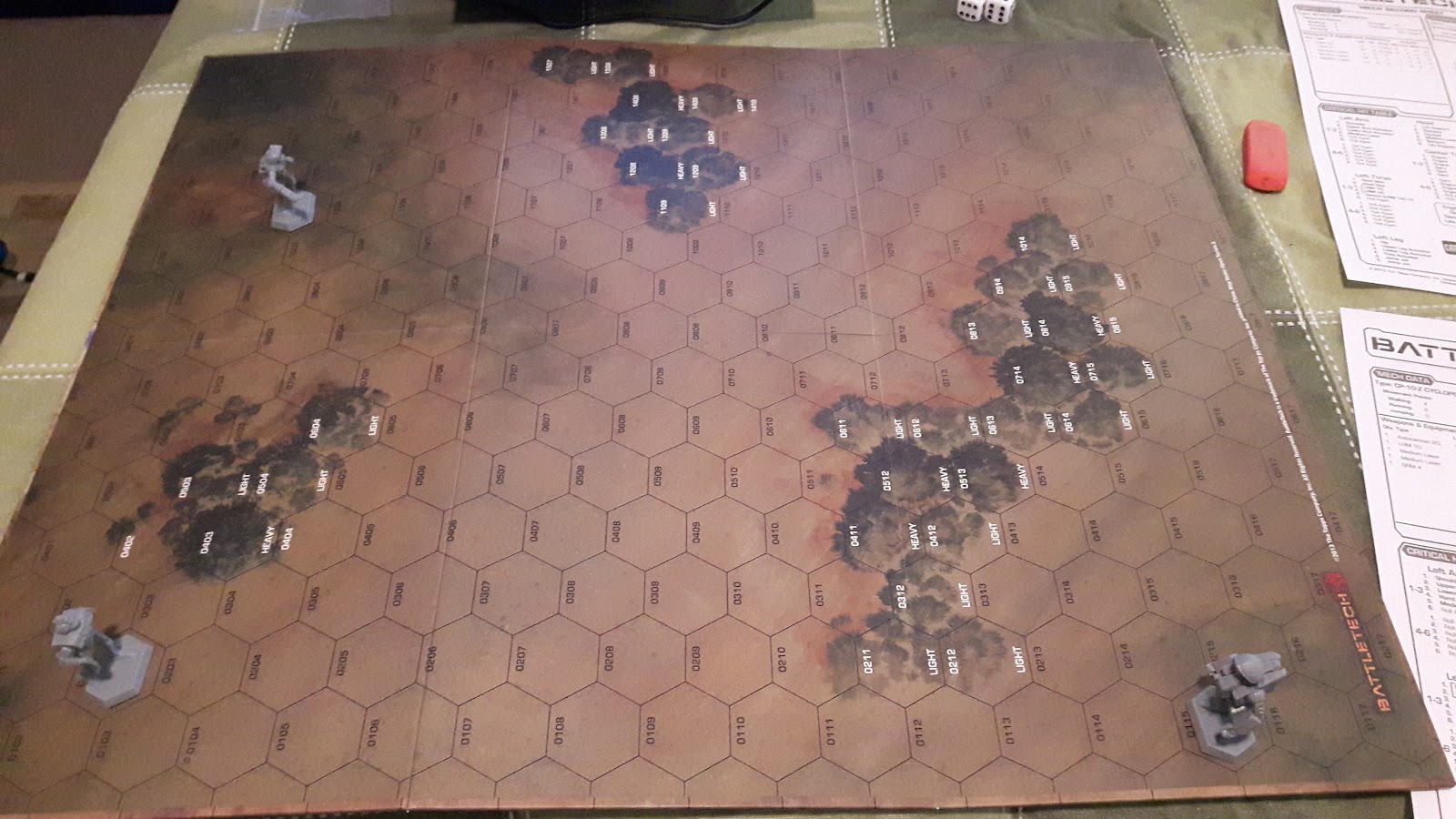
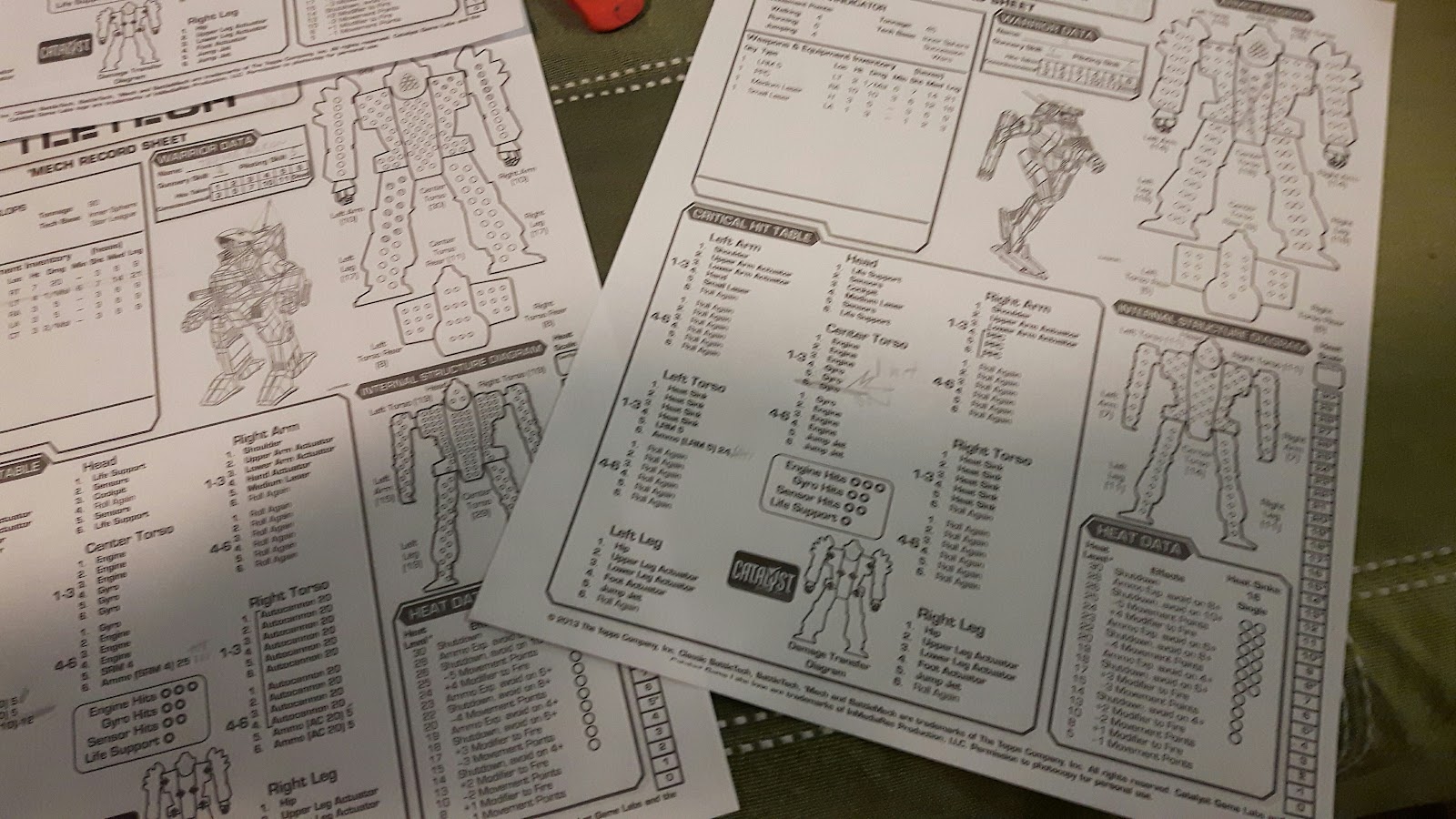
Trainee Aaron of the KRC (Karkand Recon Corps) in a CP-10Z Cyclops mech prepares to face his first round of testing, pitted against two fellow warriors in unpainted mechs fresh from the assembly line. His gunnery skill is above average and his piloting is slightly sub standard, per random rolls. (The game includes rules for rolling the two major stats for your mechwarriors, piloting and gunnery. It just so happens I rolled a fairly balanced spread, one below average in piloting and one above in gunnery)


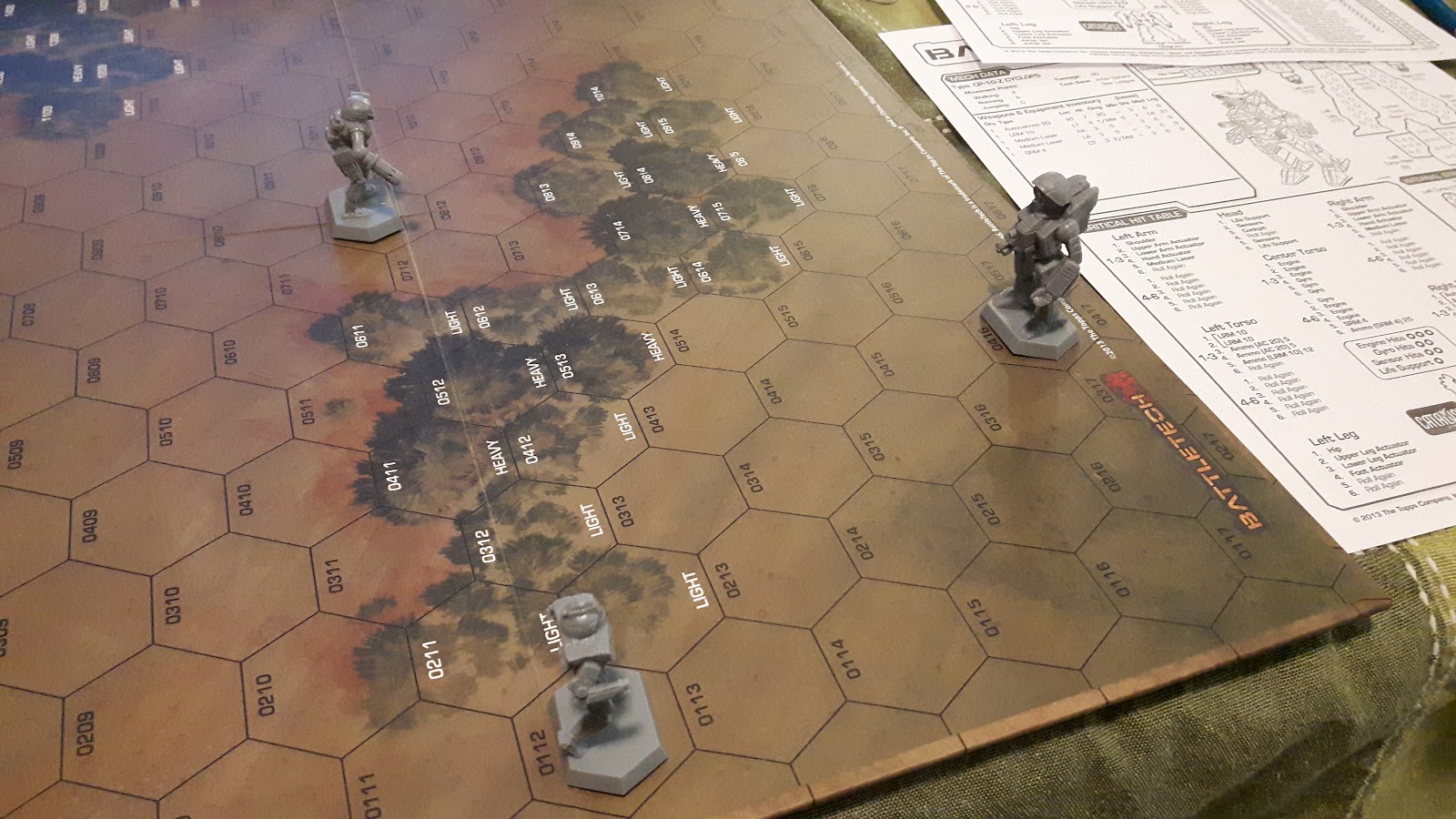
The lighter mechs close in to get past the treeline, which he is using to negate their range advantages. (Thick enough tree cover prevents vision and attack altogether, while even a few will make hitting you harder for the enemy - against two quick mechs with long range weapons, pulling them in to brawl with my monster of an Autocannon seemed like a safer bet than letting them run around and kite me until they were out of ammo)


In the ensuing fight, the cyclops loses some armour, but it's Autocannon crushes the chest of the vindicator, damaging its gyro. (The light mechs pressed through the woods on either side of my cyclops and started ablating my defenses - armour is worn down by attacks to access the more sensitive equipment inside - but I turned out to be right about the deadly combo of Autocannon 20, 3 gunnery, and close range)


Aaron closes to destroy the vindicator while its parter rushes to flank him.


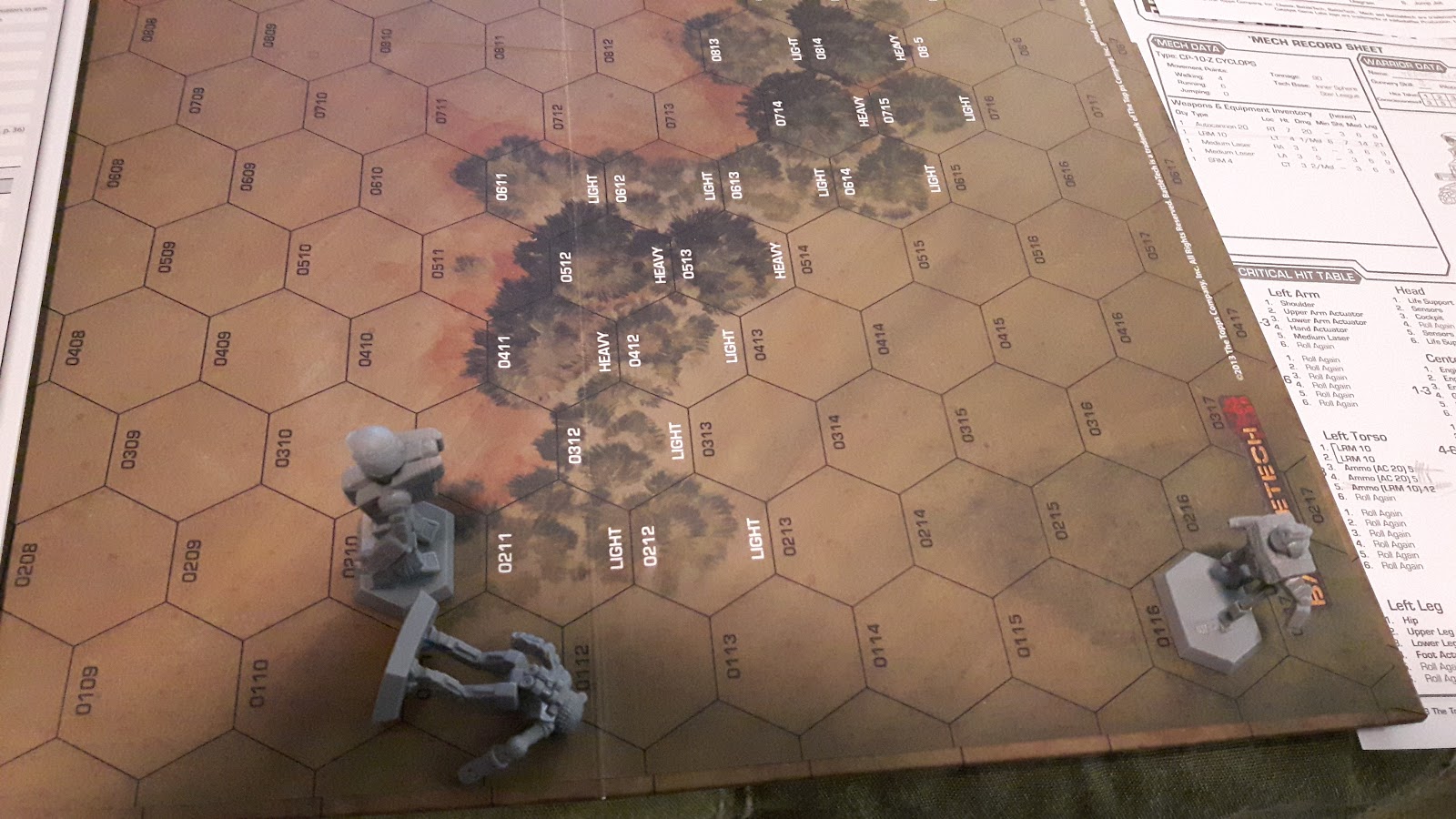
The vindicator takes another centre torso Autocannon hit and collapses, out of the fight.


The vindicator collapses alongside the torso-twisted cyclops that shattered its body. (He had tried to run past me to get out of the arc of fire of my Autocannon,  mounted in my torso. Turns out I can twist at the waist and hit him anyway!)


Shortly thereafter, the AC20 claims it's second victim, with critical damage to the engines of the Whitworth,  which by then had lost both arms, knocking it out of the fight as well.

Aaron’s mech was well-worn after the training session, but he had passed. It was time to report for more rigorous training, leading a Lance (like an armoured troop, only the tanks walk),  and get some paint on his mechs. Mercenaries earn no money in training after all."

That's all for now, thanks for checking in, and see you next time!

Tuesday, 12 April 2016

CMRT - German Armoured Reconnaissance - Part 1

Hello again, and welcome back to the Dark Ages!

Today, I'm trying out something new by introducing one of my other hobbies to the blog, and that is wargaming. In this case, computer war-gaming, using the fantastic strategic simulation series Combat Mission (Red Thunder module specifically, in this case). The battle I am showcasing is a bit of a one-sided affair, unfortunately, but they are not all like that, and if I keep up the regular e-mail games like I want to, as well as potentially some single-player action on occasion, I should be able to showcase fairly varied conflicts in the future. For now, a game between myself and my brother, I playing the Germans and he the Soviets.

SITUATION

The Germans are on the run from the Soviet steamroller. Somewhere in Eastern Europe, a reinforced Mechanized Reconnaissance unit of the Wehrmacht takes up position along an MSR (Main Supply Route) running East-West between two small farm compounds. They are closely pursued by Soviet armour, estimated to number approximately a company.

MISSION

Erste Panzer Aufklärung Battalion, under Generalmajor (If I'm interpreting Combat Mission's rank indication for my Battalion HQ correctly - though it seems a bit high of a rank for the situation!) Wünsche, is to seize and hold the farm complexes along route Bauer against Soviet attacks, in order to facilitate retreat of the Army Group deeper into Eastern Europe.

ENEMY

Enemy is estimated to be company-strength, heavily reliant on armour, though it will likely be large numbers of lower-grade soviet tanks. (It seems my brother wanted a massive tank battle, and not just an Eastern Front battle with tanks, as I understood it. This led to the significant quality difference in our forces. Oops. :S)

TROOPS

The Germans have a Reconnaissance Battalion of armoured cars, mostly with 20mm cannons, but some with heavier anti-tank armament. These have been reinforced by one Panzer VIE Tiger, and one Panzer VIB King Tiger, to lend them significant punch if proper lines of fire are established. Additionally, directly under HQ are a few dismounted scouts and tank hunters with panzerfaust disposable weapons and panzerschreck AT launchers, which will be best able to exploit terrain features as necessary.

TERRAIN

Here is the map we were working on (oriented from my deployment, at the bottom - North is left):


Now for a detailed analysis.

Observation - Right off the bat, the MSR is a long engagement area, broken up by a few rolls in the ground. It would be an optimal place for me to command as soon as possible. Similarly, the field in the North, bordered on both East and West side by treelines, is a long field of fire with a significant dip in the middle. Observation on it will be required, but troops will likely be able to maneuver in defilade if they move in quickly enough to be below the lip of the depression before my armoured cars push through the trees to watch over it. In the South, the two parallel treelines by the road break up line of sight significantly, and I will want to push at least into the nearest treeline to prevent the wide fields of fire across the farmland to the South from being dominated by the Soviets. That being said, its lines of fire to the East will be short, cut off by the next trees - here's hoping Soviet infantry with AT equipment aren't crawling in those by the time I get there!

Cover and Concealment - Of course, the treelines will provide excellent cover and concealment for overwatching fire. However, there is very little concealment or cover for forward movement. The MSR itself, lined on both sides by buildings and trees for much of its length, may provide a concealed avenue if it can be controlled, but enemy forces concealed to either side could inflict a lot of damage in an ambush. Worth noting as well are the dip in the North field and a low ridge in the South field, which may give my scouts just a bit of extra elevation, as well as somewhere to reverse behind and go gun-down if they come under fire.

Obstacles - No significant obstacles. The farmhouses are not very numerous and don't impede maneuvering much. The forests could slow vehicular movement, and we are very low on infantry to counteract that.

Key Terrain - The treelines to North and South, dividing us from the Soviet axis of advance, are Key Terrain, as they will dominate the flanks of any approach on the MSR, and will provide optimal control over both their fields and the centre. The chokepoint on the MSR at the crossroads is also Key Terrain, as it sits in a small depression and is surrounded by trees - vehicles, supported by infantry, that move in there will be able to deliver fire and disappear in any or all directions as needed.

Avenues of Approach - I identify 3 main avenues of approach : AoA North, across the Northern field, AoA Centre, down the MSR, and AoA South, across the Southern field. Notable is the fact that AoA South is open for me, but the treelines are nearest the Soviet approach. We will have to seize the treeline quickly or else lose control of that AoA immediately.

Here is an annotated map, for visualizing my analysis :


TIME

There is 1 hr and 30 min allocated to this operation, though likely, based on formation sizes, time will not be a major factor.

SCHEME OF MANOEUVRE

I intend to allocate my troops to Key Terrains 1 and 2 in particular, with the King Tiger maintaining control of Route Bauer, in order to establish control of the 3 AoAs. I expect the Soviets will mount an attack to seize those features as well. When that attack is repelled, we will mount a counter-attack along whatever route seems most advantageous, based on what we can establish of enemy dispositions after their attack.

Okay, with all of the planning out of the way, now for....

EXECUTION

The first minute of the battle is fairly uneventful, with my troops moving to their assigned positions. The Heavy Armoured Cars and Support Platoon to KT 2, 2 Section and Soldat (!? I'm really not sure about these rank insignia...) Reinhardt in the Tiger to KT 1, Soldat Pälke in the King Tiger to a small ridge to observe KT 4 from a hull-down position, and HQ to the centre with the Armoured Car Platoon pushing forward to get into KT 4 if possible, and report on enemy positions if not. The dismounts are, well, mounted, riding our tanks to take up positions in the woods near KT 1 and 4 - I don't estimate hand-held weapons will help much across AoA North, but they could be invaluable in the short spaces along the MSR and in KT 1.

Here's a flavour shot of our King Tiger and its eager riders!


Within the next minute, Palke is in position, the infantry dismount, and the armoured cars begin setting up observation wherever they are able to break through the trees. As we begin setting up, we make our first contact with the enemy :


Two T-34s are spotted, one after the other, at the far end of the MSR. Credit for this image goes to Obergefreiter Knappe, who snapped it from the back of the advancing King Tiger! The King Tiger then repositions slightly to watch the road more effectively. All teams then come to report good positioning in their Key Terrain. So far, a success.

Reinhardt, however, is not content with observing from his Tiger. Shortly after he dismounts his Tank hunters, he spots a T-34 coming through the opening in the woods ahead of him. One shot from the 88mm dispatches it fairly quickly, and he turns to congratulate his gunner, when... another T-34, then a third, come along the same route! Of course, Reinhardt has his eye on an Iron Cross today...


That's one T-34 burning in the background, a second (the lead) knocked out - you can just see the driver laying down to take cover ahead of it - and the third about to receive a warm German greeting on behalf of Reinhardt's crew. With elation in his voice, he reports a squadron of T-34s out of commission in the South. A good start! Cautiously, Reinhardt begins repositioning, pulling out behind the woods before his position can be engaged by any additional potential enemies. Those potential enemies, of course, oblige by immediately rushing into the opening, just as Reinhardt loses the ability to engage them. (Good Soviet tactics...)

An SU-76 self propelled gun and a T-34 pull up to the woods, halting just short to hunt for a Tiger that is fortunately now out of sight behind the trees (though, to be fair, I would not have favoured their odds against the front of the Tiger in any case. Of course, we didn't let those Panzer hunters ride a Tiger all the way to the front just because their legs were tired.


(The beige spot between the trees ahead of the Tank Hunters is the Panzerfaust's shaped charge in flight - spoiler alert, it connects)

With the SPG destroyed, Kruger (the Tank Hunter team leader) and his fireteam partner are ordered to try engaging the T-34 just to their front. All others hold their breath, as more vehicles are heard approaching to the North. My estimate now of a company of armour seems bang on, with their likely disposition being 3 North, 3 Centre, and 3 South, with HQ tanks and their augmentations of SPGs as the unknown agent that could pop up at any location.


Well, I need to head out and finish up my evening, so stay tuned for Part 2, in which the Soviet attack begins in earnest, and the Germans prepare for their own counterattack!

Friday, 28 February 2014

Iceland : The Arrival

Hello, and welcome back to the Dark Ages!

Today, I'll be describing my flight to Iceland, and my very first day, spent walking around Reykjavik while waiting for my bus to Vellir, the farm in Hveragerdi where I would spend the majority of my vacation.

First off, I would like to clear something up : before I went to Iceland, I had expected something similar to Yellowknife (which I visited for work last summer), a Northern community with a rocky, forested natural setting.

This is not the case. Reykjavik itself looks like a typical Dutch town, of all things (Well, generally Northern European, but my first thought was of the town of Brunssum, in Limburg, so that is the example I will use), and the countryside of Iceland is virtually barren when it comes to trees. The nearest they come to forested land is patches of "trees" that a Canadian may call worthy of a hedgerow.

It is worth noting that they are trying their best to rectify this by planting more forests, more on that later.

The major landmark in Reykjavik is Hallgrimskirkje, the massive cathedral at the town's centre (as far as I could tell; it is almost directly North of BSI, the main bus terminal, and halfway from the water to the South to the water to the North, so it seems central enough). The most defining feature about it, I would argue, is its incontestably modern architecture.

See here :


The contours of the spire (if that is the correct word) are the part that catch the eye the most. If they look like they are made of concentric pillars working their way up to the top, well then they look exactly like what they are. The gaps between those vertical lines serve as windows for the wings of the church itself.

Of course, while you are there, you have to climb to the top of the spire, and take a look around. What you see then will be your first hint that you are, to paraphrase the cliché, not in Limburg anymore :


The city is surrounded by magnificent ridgelines, and is, in fact, not even close to the size of what we from the West may consider to be a typical city.

That impression will stay with you if you, as I did, decide to wander around the town itself afterwards. Everything has a small-town kind of feel, streets are small and cozy, and the food, well...

I felt like I was cheating when, in the middle of Reykjavik, I stopped at a location called Le Bistro, clearly styled after a French Café and not anything remotely Icelandic. However, the food I had there, a meal called the Farmer's Breakfast, was delicious and also included what I would find to be the most typically Icelandic food available : Skyr. (Seen at the lower left of my tray in the picture)


Skyr is a strange substance. While some will tell you that it has the consistency of yoghurt, they would be right half the time, but also not cover nearly all of the complexities of the dish. Basically, Skyr is a cheese product, that comes in some variation on a creamy consistency. It can be flavoured with outside substances in all sorts of ways, and can come with different degrees of cheesy flavour under all that. I'll have Skyr several more times on this trip, so expect more on that, but suffice to say that this particular Skyr tasted somewhat cheesy, had a consistency almost like thick yoghurt, and was topped only with granola.

The Skyr I had afterwards, however, was in a dish they cleverly titled Skyramisu, and was artificially coffee-flavoured, with a fluffier consistency. Aha! Already with the variation!

In any case, once my brunch had been satisfactorily introduced to my digestive tract, I headed out onto the town, with the intention of visiting the National Museum and the Culture House.

I'm sure you will be disappointed to know that, on the Winter schedule, basically all museums in Reykjavik are closed on Mondays, bringing my exploration to a bit of a crawl. Instead of visiting those, I did a lap of the town, visiting the University Park and City Hall on my way back to the bus station. 


And that basically concludes my first impressions of Reykjavik. Shortly thereafter, I was in a van on the way to Vellir, where I began riding with the Eldhestar stables, a fantastic experience I would recommend to any of you!

I hope you all enjoyed this, and please feel free to tell me if you did (or didn't), and tell me why, so the Dark Ages can continue to please!

Thanks very much, and I look forward to our next post, which will be (for real this time) my second post on Combat in UARPS.

Bless bless!

Wednesday, 11 December 2013

Introduction to the Universal Advanced Role-Playing Game


Welcome back to the Dark Ages! Here is the first post in the UARPS-related podcast and blog post series. Apologies for any issues with microphone quality, I only have a headset mic available at the moment, but I did my best to clean up the audio in the cutting room afterwards.

The UARPS files will be up on Drive shortly, once they undergo a final revision and can be exported to PDF. If you have issues with that format, give me a shout in the comments section and we'll see what can be done, but it seems like the most widespread (if not my preferred) format to use.

Enjoy, and please leave a comment if you have one! EDIT : Redid the first post, for clarity of audio and content.

Tuesday, 10 December 2013

Introduction and Licensing

Welcome to the Dark Ages!

This post will serve to establish the guidelines under which I'll be operating on this blog. Simply put, this site is going to be a place for me to discuss opinions and works in a public setting, allowing for reader input and mature discussion on those subjects. It is my hope that you as readers are going to take advantage of this opportunity and leave a message or response on posts, stimulating the community!

I'll be touching on a variety of subjects that interest me on this site, but you can expect tabletop gaming, history, reading / writing and perhaps some illustration to be the staples of the site, as these are all domains in which I have done a fair amount of my own work, and which I feel confident discussing. My own education is in the realm of Political Science, with a particular specialization in geo-politics and philosophy, but I will do my best not to raise political issues, instead applying the skills I learned to less hot topics. While I hope that the community here will be a mature one (hence why I avoided YouTube, that wretched hive of scum and villainy), there are some buttons that are best not pressed, unless I am confident I can do so in an educated and even-handed way, and expect the same in return.

Before I leave you to explore the real meat and potatoes of this site, one major point still needs to be made clear. All items on this blog, text, images or otherwise, are licensed to myself under a Creative Commons Attribution-NonCommercial-NoDerivs 3.0 Unported License, unless otherwise stated in that particular post. What this basically means is that you can repost any of the goods that fall under this license as long as you credit me and link back here, and you make no money from them.

With all that said, I hope you enjoy what you are about to delve into, and of course, enjoy responsibly!